10 Badminton Footwork Drills to Improve Speed and Court Coverage
Improve your badminton movement with 10 practical footwork drills designed to develop speed, balance, coordination, recovery and efficient court coverage.
10 Badminton Footwork Drills to Improve Speed and Court Coverage
Good footwork is one of the most important skills in badminton. It allows you to reach the shuttle early, maintain balance, play better shots and recover before your opponent attacks again.
Many beginners focus mainly on racket technique. They practise smashes, clears and drops but ignore how they move around the court. Even an excellent stroke becomes difficult when you arrive late or contact the shuttle from an unbalanced position.
Badminton footwork is not simply about running faster. Efficient players use small preparation movements, controlled steps, lunges, crossovers and recovery patterns. They cover the court while using less energy than someone who moves without proper technique.
The following drills can help beginners and improving players develop faster, safer and more efficient movement.
Before Starting the Drills
Begin with a short warm-up to prepare your muscles and joints for rapid directional movement.
A simple warm-up can include:
- Three to five minutes of light jogging
- Arm circles and shoulder rotations
- Hip and ankle rotations
- Walking lunges
- Gentle side shuffles
- High knees
- A few slow shadow movements
Wear proper badminton shoes with good grip and lateral support. Make sure the court is dry and free from loose shuttlecocks, bags or other objects.
Start each drill slowly. Correct movement is more important than maximum speed.
1. Ready Position and Split-Step Drill
The split step is a small preparation movement performed as your opponent hits the shuttle. It helps you react quickly in any direction.
How to perform it
- Stand near your normal base position.
- Keep your feet approximately shoulder-width apart.
- Bend your knees slightly.
- Hold the racket in front of your body.
- Make a small hop.
- Land lightly on the front of both feet.
- Push immediately toward a direction called by your training partner.
- Return to the starting position and repeat.
If you are practising alone, use a timer or randomly choose a direction after each landing.
Key points
- Keep the split step small and quick
- Land with your knees slightly bent
- Avoid landing heavily on your heels
- Keep your body relaxed
- Do not jump too early
- Begin moving immediately after landing
The timing matters more than the height of the jump. During a match, try to land as the opponent contacts the shuttle.
Suggested routine
Complete three sets of 10 split steps with 30 seconds of rest between sets.
2. Six-Corner Shadow Footwork
Shadow footwork means moving around the court without hitting a shuttle. It allows you to concentrate completely on your steps, balance and recovery.
The six main court areas are:
- Front forehand corner
- Front backhand corner
- Mid-court forehand side
- Mid-court backhand side
- Rear forehand corner
- Rear backhand corner
How to perform it
- Begin at your base position.
- Perform a split step.
- Move toward one of the six corners.
- Pretend to play the appropriate shot.
- Recover to your base position.
- Repeat toward another corner.
Move slowly during the first few sessions. Check whether you remain balanced at each corner and whether you return efficiently.
Key points
- Prepare the racket while moving
- Keep your upper body controlled
- Avoid crossing your feet unnecessarily
- Use a lunge in the front court
- Turn your body when moving backward
- Recover immediately after the imaginary shot
Suggested routine
Work for 30 seconds, rest for 30 seconds and complete four to six rounds.
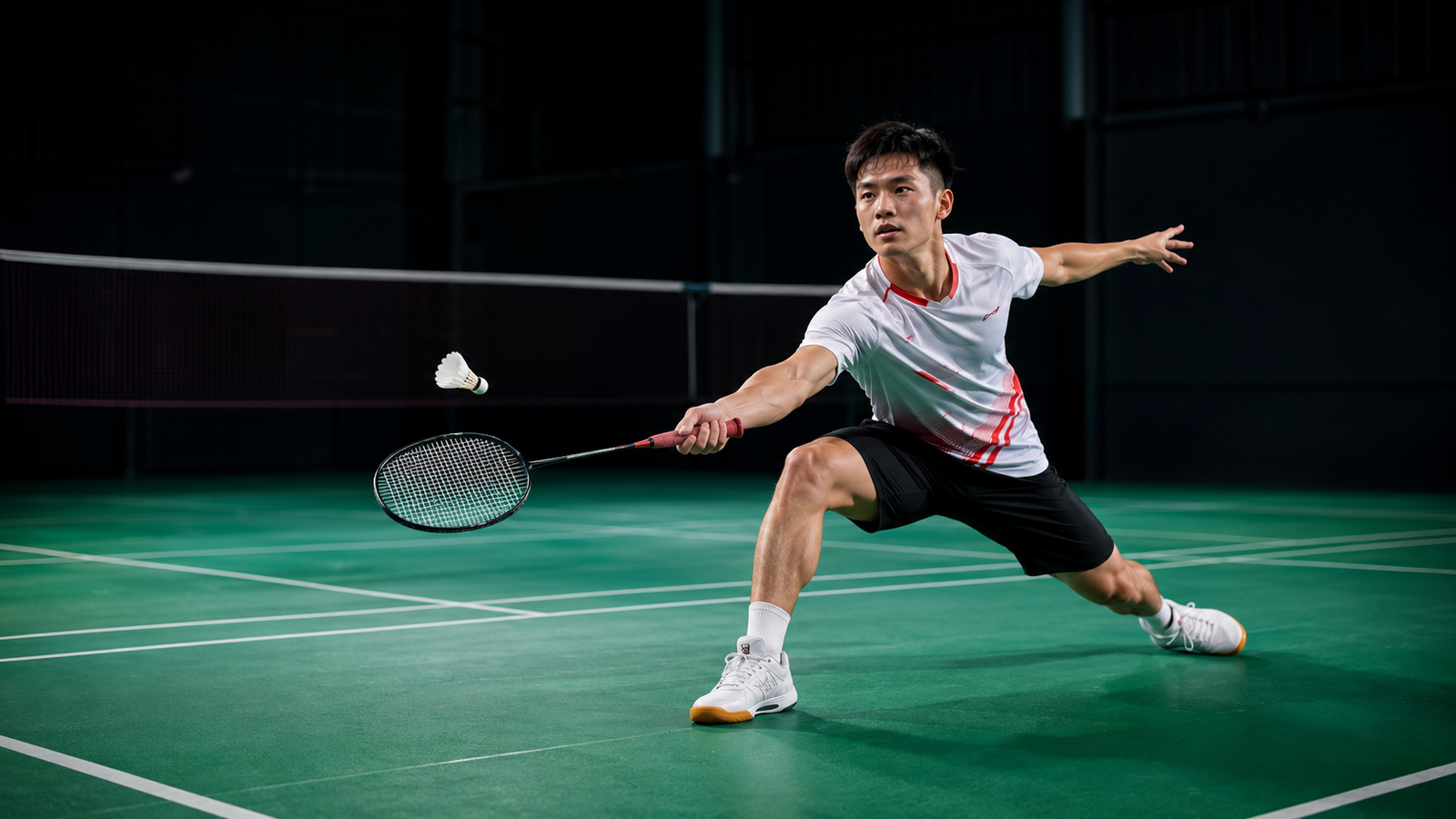
3. Front-Court Lunge and Recovery Drill
A controlled lunge helps you reach net shots while maintaining balance. It also protects your movement by allowing the leg muscles to absorb the landing.
How to perform it
- Start at the base position.
- Perform a split step.
- Move toward the front forehand corner.
- Place your racket-side foot forward.
- Land heel first and allow the foot to roll toward the toes.
- Keep the knee aligned with the direction of the foot.
- Pretend to play a net shot.
- Push backward using the front leg.
- Recover to the base position.
- Repeat on the backhand side.
Your final step should be long enough to reach the shuttle, but it should not force you into an uncontrolled stretch.
Common mistakes
- Allowing the knee to collapse inward
- Landing with a completely straight leg
- Leaning too far forward
- Dragging the back foot excessively
- Remaining at the net after the shot
- Looking down instead of forward
Suggested routine
Perform eight lunges to each front corner. Complete three sets with adequate rest.
4. Side-to-Side Defence Drill
This drill improves lateral movement for defending smashes, intercepting drives and covering the middle areas of the court.
How to perform it
- Stand in a defensive position with your feet wider than shoulder width.
- Keep your knees bent and racket in front.
- Perform a small split step.
- Push toward the forehand side.
- Make a short defensive swing.
- Return toward the centre.
- Push toward the backhand side.
- Continue alternating between both sides.
Use short, controlled movements. Your body should remain low enough to change direction quickly.
Key points
- Keep the racket in front of your body
- Avoid standing upright between movements
- Push from the outside leg
- Take quick recovery steps
- Maintain a relaxed grip
- Keep your head stable
Suggested routine
Move continuously for 20 seconds, rest for 30 seconds and complete five rounds.
5. Rear-Court Chassé Drill
Chassé steps are quick side movements in which one foot leads and the other follows without fully crossing. They are useful when moving toward the rear court while maintaining a side-on position.
How to perform it
- Begin at the base position.
- Perform a split step.
- Turn your hips and shoulders toward the rear corner.
- Move backward using controlled chassé steps.
- Raise your racket into the overhead preparation position.
- Pretend to play a clear, drop or smash.
- Push forward and recover to the base position.
- Repeat on the opposite side.
Do not move directly backward while facing the net. Turning sideways allows faster movement and better overhead preparation.
Suggested routine
Perform six repetitions toward each rear corner. Complete three sets.
6. Scissor-Jump Recovery Drill
The scissor jump helps players recover after playing an overhead shot from the rear court. It combines body rotation, weight transfer and forward recovery.
How to perform it
- Move toward the rear forehand corner.
- Position your racket-side leg behind you.
- Turn your body sideways.
- Prepare for an overhead stroke.
- Rotate your hips and shoulders forward.
- Switch the position of your legs during the hitting action.
- Land with your non-racket leg behind you.
- Use the landing to begin moving forward.
- Recover toward the base position.
Practise without jumping high. The objective is an efficient leg switch and fast recovery, not maximum airtime.
Common mistakes
- Jumping without body rotation
- Landing heavily
- Losing balance after the stroke
- Facing forward too early
- Forgetting to recover toward the centre
Suggested routine
Perform five controlled repetitions, rest and complete three sets.
7. Shuttle-Pickup Footwork Drill
This drill uses shuttlecocks as targets and adds a clear objective to your movement.
Setup
Place several shuttlecocks in one front corner. Put an empty tube or small container near your base position.
How to perform it
- Start beside the container.
- Perform a split step.
- Move toward the corner.
- Lunge and pick up one shuttlecock.
- Recover to the centre.
- Place the shuttle in the container.
- Repeat until all shuttlecocks have been collected.
- Move the shuttlecocks to another corner and repeat.
You can also place one shuttle in each of the six corners and collect them in sequence.
Why it works
This drill develops:
- Directional movement
- Balance during lunges
- Low-body control
- Recovery speed
- Repeated court coverage
- Basic badminton endurance
Suggested routine
Use six shuttlecocks and complete two or three rounds. Rest fully between rounds if your technique begins to break down.
8. Partner Pointing Drill
The partner pointing drill introduces unpredictability. Unlike a fixed movement sequence, you do not know which direction you must cover next.
How to perform it
- Stand at your base position.
- Ask your partner to stand near the opposite side of the net.
- Perform a split step.
- Your partner points toward one of the six court areas.
- Move toward that area and perform an imaginary shot.
- Recover to the base position.
- Wait for the next direction.
Your partner should begin at a manageable speed. Directions can become faster and less predictable as your movement improves.
Progressions
Your partner can:
- Point toward different corners
- Call numbers assigned to each corner
- Use racket movements instead of pointing
- Include occasional pauses
- Call the type of imaginary shot
- Increase the duration of each round
Suggested routine
Complete four rounds of 30 seconds with 45 to 60 seconds of rest.
9. Multi-Shuttle Movement Drill
Multi-shuttle training combines footwork with real shots. A coach or partner feeds several shuttles to different parts of the court while you move, hit and recover.
How to perform it
- Begin in your base position.
- Ask your feeder to send shuttles to two selected corners.
- Move to each shuttle using the correct footwork.
- Play a controlled shot.
- Recover before the next feed.
- Gradually add more court areas.
Beginners should not begin with all six corners at high speed. Start with predictable feeds and focus on movement quality.
A useful progression is:
- Two front corners
- Two rear corners
- One front and one rear corner
- Four corners
- Random six-corner feeding
Key points
- Recover after every shot
- Ask for slower feeds when technique becomes poor
- Maintain proper racket preparation
- Avoid reaching desperately for impossible shuttles
- Focus on consistency before intensity
Suggested routine
Begin with eight to 12 shuttles per set and complete three to five sets.
10. Court-Corner Interval Drill
This is a more physically demanding drill that develops movement endurance and the ability to maintain footwork under pressure.
How to perform it
- Begin at the base position.
- Perform a split step.
- Move to the front forehand corner and return.
- Move to the rear backhand corner and return.
- Move to the front backhand corner and return.
- Move to the rear forehand corner and return.
- Continue for the selected time.
You may change the sequence, but always maintain controlled movement.
Suggested routine
For beginners:
- Work for 20 seconds
- Rest for 40 seconds
- Complete four rounds
For improving players:
- Work for 30 seconds
- Rest for 30 seconds
- Complete five or six rounds
Stop the drill when fatigue causes poor balance, uncontrolled landings or incorrect steps.
How to Practise Footwork at Home
You can practise several footwork patterns without a full badminton court.
Find a clear, non-slip space and mark a centre position using removable tape. Add four or six direction markers around it.
You can then practise:
- Split steps
- Short lunges
- Side shuffles
- Chassé steps
- Shadow footwork
- Racket preparation
- Movement and recovery patterns
Keep the movements compact if the space is limited. Avoid practising fast backward movement near furniture, walls or stairs.
Even 10 to 15 minutes of controlled home practice can improve coordination when performed consistently.
A Simple Weekly Footwork Plan
Beginners do not need to perform every drill in one session.
Session One: Movement Fundamentals
- Warm-up
- Split-step drill
- Front-court lunge drill
- Rear-court chassé drill
- Slow six-corner shadow footwork
- Cool-down
Session Two: Speed and Reaction
- Warm-up
- Split-step drill
- Side-to-side defence
- Partner pointing drill
- Shuttle-pickup drill
- Cool-down
Session Three: Match Movement
- Warm-up
- Six-corner shadow footwork
- Scissor-jump recovery
- Multi-shuttle movement
- Court-corner intervals
- Cool-down
Allow adequate recovery between demanding sessions, especially when you are new to footwork training.
Common Footwork Mistakes
While practising, watch for these common problems:
- Skipping the split step
- Standing too upright
- Moving with the racket lowered
- Taking too many unnecessary steps
- Crossing the feet at the wrong time
- Reaching instead of moving closer
- Arriving without balance
- Watching the shuttle after hitting
- Remaining in the corner
- Returning automatically to the exact centre
- Continuing after technique becomes uncontrolled
Footwork should help you arrive in a position where you can play a quality shot and recover efficiently.
How to Improve Faster
Consistency is more valuable than one exhausting training session.
Practise footwork two or three times per week. Record a few drills using your phone and check your posture, balance, racket preparation and recovery.
Begin slowly enough to notice mistakes. Increase the speed only when you can complete the movement correctly.
When possible, work with a qualified badminton coach. A coach can identify technical problems that may be difficult to notice on your own.
Final Thoughts
Better footwork can improve almost every part of your badminton game. You will reach the shuttle earlier, create more shot options and recover with less wasted movement.
Start with the split step, lunges and basic six-corner movement. Once these foundations feel comfortable, introduce unpredictable partner drills, multi-shuttle feeding and interval training.
Do not try to move at professional speed immediately. Build correct patterns first. Speed will develop naturally as the movements become familiar.
A player with efficient footwork often appears faster because they anticipate well, take fewer unnecessary steps and remain balanced throughout the rally.